
BREATHING FOR SINGING
To sing well, you must have excellent breath control.
Breathing for singing is very different from everyday breathing. So what’s the difference?
I will describe everyday breathing, then breathing for singing. That way you’ll be clear on the difference.

Everyday Chilled out Breathing
Everyday normal breathing consists of a shallow inhale and exhale. I am assuming that you are sat down chilling out for this reference, not running after a bus!
We inhale and exhale for around the same amount of time. It’s important to note that this is subconscious, automatic. We don’t need to worry about it in anyway. It will always happen!
WHY BE AWARE OF BREATHING?
For the purpose of singing, however, we must be made aware of breathing, so that we can learn to monitor and correct it when we go wrong. Breathing often goes wrong due to a misunderstanding of correct breathing or due to bad posture.
How is Breathing for singing different to everyday breathing?
Now you understand everyday breathing. It’s time to look at the differences between it and breathing for singing. There are four main differences.
- The exhale is much longer than the inhale.
- The exhale must be even in.
- The breathing to start with must be under conscious control (recall that everyday breathing is subconscious).
- The amount of air that we use is up to 50% of what’s in your lungs ( unlike everyday chilling out which is around 5% to 10%).
So in difference 1 (from the list above). I said that the exhale is longer than the inhale. So why is that? If you’re singing a note, are you inhaling or exhaling? The answer is you’re exhaling (breathing out).
So we sing on the exhale.
SINGERS ARE ATHLETES
The longer the lyric line that we have to sing on with one breath the more air we need. You could use up to 50% of your lung capacity. The only other time you would use this much air is in sports. You’re a vocal athlete! To get that much air quickly, you need good posture.
You might like to see some animated lungs in action to get a feel for what’s going on. If you want to find out more about posture, then check out posture for singing.
Breathing for singing Monitoring Hand Positions
(Monitoring hand position 1)
Place your hands on the areas that you can see in picture (1). Your touch should be light but not so light that you can’t feel the action of the lower and upper belly movements as you breathe.
You will need to play around with your hand firmness a bit and positioning until you can feel these areas moving as you breathe. It should never feel uncomfortable for your hands or your body.

Breathing For Singing – Hand Position (1)
Feel the Lower and upper belly moving under the palms of your hands as you breathe in and out.
Monitoring hand position 2
Although I have added this hand position to the monitoring process, strictly speaking, it’s more a posture check as the rib cage should always be in an open (hooked up) position. Without this hooked up chest feeling the lungs will not have the space they need to breathe efficiently. This lack of space in the chest will leave you running out of breath far too soon.
NO BACK ARCHING
So place a hand on your rib cage just below the collar bone. As you breathe, you want to work on keeping the hooked up rib cage feeling. Make sure that you do not arch your lower back to give the illusion of an open chest.
As you breathe out, you will feel like the waist pulls in more and more as you exhale giving you a sensation of pulling on the ribcage in an inward direction. This sensation will increase as you breathe out more.
While working on the rib cage never hold it open in a rigid way as this will create tension in the body especially the neck. We always want a flexible firm and responsive body.

Breathing For Singing – Hand Position (2)
You want to try to keep your chest in the open hooked up position when you breathe in and out.
monitoring hand position 3
Place one hand in the same location as you did in hand position (2) on the chest just below the collarbone. Now take the other hand and place it on the lower belly as you did in hand position (1). You can now monitor your lower belly breathing movements and make sure that your chest is still open.
Only move onto this hand position once you’re happy that you are aware enough of the upper belly movement from hand position (1).
You should still regularly go between the hand positions always checking that every part is doing as it should.

Breathing For Singing – Hand Position (3)
With this hand position you can check your chest to make sure it stays hooked up and your lower belly for correct movement when you breathe.
That’s the chest and belly movements taken care of, now on to the sides. Although we started with the chest and belly monitoring positions, there’s nothing to stop you from starting at the sides. Just make sure that you become aware of all the hand positions so that you can lose the hands-on approach as soon as possible.
monitoring hand position 4
We want to be able to monitor the sides of the waist. That’s just above the hips and below the ribs at the sides.
Shape your hands like in (4A). Then horizontally (4B) and place them around your waist like in (4C). Again make a loud hiss sound, you should feel the sides kick out.

Hand Position (4a)
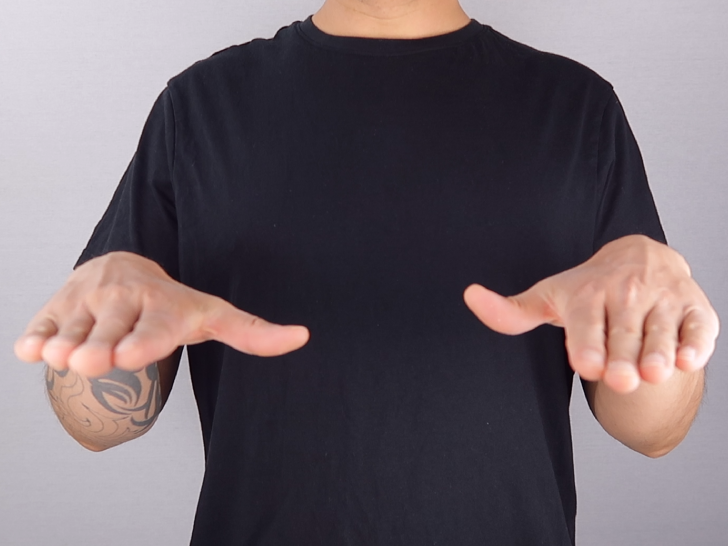
hand position (4b)
If you don’t then try a louder hiss sound and play around with your hand positions. You should feel a push out against the sides of your hands.
Still no joy? Then try a pulsing hiss sound. Now you should feel the sides pushing against your hands and then relaxing a little.

Hand position (4C)
Now, let’s focus on the thumbs (4D). Making a loud hiss again, notice how the lower back area (Lumber area) pushes against the thumbs.
You may have to focus a lot to feel this movement as it’s very subtle. In fact, this is the one where all my students need help. When they do eventually notice it, they are surprised at how subtle it is! Stick with it. With a little bit of patience, you will get it.

Hand Position (4D)
You should practice all the hand positions until you’ve enough awareness of the sensations of breathing, in the lower back, the sides of the waist, lower belly, upper belly and chest. Even then still go back to using the hands on now and then just to check that you’ve not got sloppy.
NOTE:
With any breathing work, you should always go at your own pace. If you start to get light headed when you are working on your breathing, then stop. Take some time to breathe normally until you feel better then start again or you could just try again tomorrow.
Where to Next?
Now you’re clear on the difference between everyday breathing and breathing for singing. Time to learn about the correct way to breath. If you think its belly breathing, then you should read How to Breathe When Singing as I explain the correct method of breathing for singing there.
You could check out 4 great vocal techniques to get your voice going! There are some great vocal technique sounds on there with video examples for you to try.
If you’re interested in singing lessons with me then you can find out more information on my singing lessons page.

Hi, I’m Dylan, I’ve been teaching people to sing professionally now for 20 years! I love my job and helping people to sing their very best.
That’s why I created this website (vocaltechnique.co.uk) to help people that want to teach themselves to sing or just want to know more about singing.
It’s been my pleasure to help all levels of singer to reach their singing dreams.
My new singing course “How the Singing Voice Works” is below. Check it out if your interested as I’m giving away a whole section of the course for free in the trial 🙂